Affiliate Disclosure:This article contains affiliate links. If you purchase through our links, we may earn a small commission at no extra cost to you. We only recommend gear we've tested or would genuinely use ourselves.
buying guide • May 15, 2026 • 16 min read · The Bite Intel Team
Kayak Fishing Accessories: What to Buy First, What to Skip, and How to Build the Right Setup
Which kayak fishing accessories are worth buying? We break down every category by priority and budget — rod holders, anchors, fish finders, and more.
Most anglers buy a kayak and then spend the next six months making expensive mistakes. They grab whatever looks good in a YouTube thumbnail — a fancy trolling motor they don't need yet, rod holders that don't fit their hull, a fish finder mounted in the worst possible spot. Six hundred dollars later, they've got a cluttered boat and no system.
Kayak fishing accessories have a logical order. Get the foundational gear right first, and every subsequent purchase builds on it. Get it backwards, and you'll spend twice as much course-correcting.
This guide breaks down every accessory category by purchase priority for freshwater anglers targeting bass, crappie, and catfish. Within each category we give you specific picks at two budget tiers. If you're starting from scratch, read straight through. If you're filling a specific gap, jump to the section you need.
The Right Order to Buy Kayak Fishing Accessories
Before buying anything, settle on a priority framework: safety first, then fish-catching ability, then comfort, then convenience upgrades. This prevents the common trap of spending $200 on a camera mount before you have a reliable way to anchor in current.
Priority 1 — Safety (non-negotiable): PFD, paddle leash, signaling devices
Priority 2 — Core fishing functionality: Rod holders, anchor system
Priority 3 — Electronics: Fish finder, GPS mount
Priority 4 — Storage and organization: Crate, dry bags, tackle boxes
Priority 5 — Comfort and convenience: Upgraded seat, cooler, lights
According to the U.S. Coast Guard's 2023 Recreational Boating Statistics, 85% of drowning victims in kayak and canoe accidents were not wearing a life jacket at the time of the incident. Sort the PFD before you spend a dollar on anything else.
Most anglers who've been running fishing kayaks for more than two seasons will tell you the same thing: they wish they'd followed this order. The ones who skipped straight to electronics or trolling motors almost always end up coming back to buy rod holders and an anchor system anyway — they just paid full price twice.
Rod Holders — The First Upgrade Every Kayak Angler Needs
Rod holders are the single most impactful kayak fishing accessory after a proper paddle. The right setup keeps rods accessible while paddling, positions trolling lines at the correct angle, and frees both hands for landing fish. The wrong setup leaves rods bouncing loose or locked at a fixed angle that doesn't match how you actually fish.
Two systems exist: flush mounts (permanent, drilled into the hull) and track mounts (bolt to a gear track rail, fully repositionable without drilling). For anyone who hasn't committed to a permanent layout, track mounts are the smarter first buy. You can reposition them until you find the angles that work for your style, then commit to flush mounts once you know exactly where you want them.
| Product | Rating | Price | Best For | Link |
|---|---|---|---|---|
| YakAttack Omega Pro | 4.7/5 | $35 | Adjustable 360° rotation, universal rod fit, track mount | Check Price |
| Scotty 241 Baitcaster | 4.5/5 | $28 | Affordable flush mount, holds spinning and baitcast rods | Check Price |
| YakAttack GearTrac Short | 4.6/5 | $22 | Rail foundation for any track-mount accessory | Check Price |
Two rod holders is the minimum for freshwater bass or crappie fishing. If you're running a crankbait on a slow troll and want to pitch a jig to structure you just spotted, you need both rods secured while you set up the cast. Most sit-on-top fishing kayaks ship with two factory-installed flush mounts. Add two more via track mounts or side rail positions and you've covered most freshwater scenarios.
The YakAttack Omega Pro earns its spot on nearly every serious kayak setup because the 360° rotation locks at any angle — flat for trolling, angled up for storage while paddling, angled out for a second active rod while you work another. At $35 it's the most versatile single accessory upgrade you can make.
For a full breakdown of flush mount vs. track mount options at every price point, see our kayak rod holder buying guide.
Anchor Systems — The Accessory Forum Anglers Argue About Most
The right anchor system depends entirely on your water type. There is no universal answer, and most buying guides pretend otherwise. Here's the breakdown by situation so you can pick the one that matches how you actually fish.
Folding grapnel anchor (~$20): Works on hard bottoms — gravel, rock, clay, and sand. Useless in soft silt or mud. The Extreme Max 3006.6548 folds flat, weighs 1.5 lbs, and holds reliably in current up to about 1.5 mph on hard bottom. Always pair it with an anchor trolley so you can reposition from bow to stern without pulling the anchor up — without one you're fighting the boat every time the wind shifts.
Stake-out pole (~$35–$50): For skinny water under 6 feet with any bottom type. Push it through a rod holder or dedicated mount, lock position, and the boat stops moving. No rope to manage, no re-anchoring when the wind changes. On shallow flats targeting crappie or when working bass along a shoreline, a stake-out pole is faster and quieter than any grapnel setup.
Brush anchor (~$25): The one accessory that almost no editorial buying guide mentions — but shows up in nearly every forum thread about kayak fishing must-haves. A small alligator-style clamp that grips branches, dock posts, and fence lines. If you fish flooded timber, laydowns, or dock pilings, this replaces a traditional anchor entirely for most situations. No chain, no rope, no weight. Just clip on and fish.
Power-Pole Micro (~$450): Remote-controlled stake-out for water up to 8 feet deep. Overkill for most recreational anglers, but worth it if you fish tournaments where silent, fast repositioning is the difference between catching and not. Mounts to a RAM ball or YakAttack mounting plate and controls via Bluetooth from your phone or a wrist remote.
Check Price: Folding Grapnel Anchor Check Price: YakAttack LeverLoc Anchor TrolleyThe anchor trolley — a pulley-and-ring system that runs along the gunwale — is not optional if you're running a grapnel in anything other than dead-calm water. Without one, you're fixed at whatever angle you dropped. With one, you slide the ring from bow to stern in seconds and the boat weathervanes into the wind or current exactly where you want it. The YakAttack LeverLoc HD (~$40) installs in under an hour with four stainless screws and works on any sit-on-top hull.
Tip
For full installation walkthrough and trolley system comparisons, see our anchor trolley buying guide.
Fish Finders and Electronics Mounts
A fish finder on a kayak does two things: shows you structure and depth so you make better decisions about where to cast, and in cold water it pinpoints the exact temperature layer the fish are holding in. You don't need one to catch fish, but it compresses the learning curve on unfamiliar water significantly.
The Garmin Striker 4 (~$130) is the correct baseline buy for freshwater kayak fishing. CHIRP sonar reads structure cleanly in the 8–30 foot range you'll actually fish. Built-in GPS saves waypoints — that submerged brush pile at 12 feet, the ledge where crappie stacked in March. It powers from a small 7Ah lithium battery or a USB power bank with a converter cable, so no permanent wiring is required.
The Lowrance HOOK Reveal 5 (~$175) adds side-imaging and down-imaging via a TripleShot transducer. Side imaging changes how you read cover entirely — laydowns and dock pilings that show as vague blobs on standard 2D sonar appear as clear horizontal images. Worth the $45 premium if you fish reservoirs with heavy submerged structure.
For the mount, use a RAM Mount RAM-B-202U ball base (~$25). It bolts to any gear track or screws to a factory-drilled mount point, and the ball system is universal — your phone mount, camera, and fish finder all use the same ball diameter, so you can swap and reposition everything without buying new hardware for each device.
Check Price: Garmin Striker 4For a full head-to-head comparison at every price point, see our best fish finder for kayak guide.
Tackle Storage — What Actually Fits on a Kayak
The biggest storage mistake is trying to bring as much tackle as you'd carry in a bass boat. A kayak cockpit is not a bass boat. You have one rear tank well, a bow hatch if your model includes one, and whatever you can secure to the side rails. Pack for the specific trip, not for every possible scenario.
Kayak crate: The rear tank well is the most versatile storage space on the boat. A dedicated kayak crate organizes it and adds rod tube positions for rods that don't fit the flush mounts. The Plano Weekend Series Kayak Crate (~$45) ships with four vertical rod holders and a removable floor tray sized to fit Plano 3600 boxes exactly. It fits most 12"–14" tank wells and adds about 2 lbs to your setup. See our full kayak fishing crate guide.
Tackle boxes: Plano 3600 Series boxes (~$12 each) drop into the Plano crate tray and stack in the tank well without sliding. For a day trip, carry two: one for hard baits (crankbaits, jerkbaits, swimbaits), one for soft plastics and terminal tackle. That's it. If you're reaching for a third box on a kayak, you brought too much.
Dry bag: Non-negotiable for phone, wallet, and car keys. The Sea to Summit Ultra-Sil Nano (~$25) packs to the size of a baseball, weighs 1.3 oz, and floats when sealed — relevant if you capsize and your bag goes over the side. Use a 2L for a phone and keys. Add a 10L if you need a change of clothes for a longer paddle. See our dry bag buying guide for sizing details.
Check Price: Plano Kayak CrateSafety Accessories (What USCG Actually Requires)
Every kayak in U.S. waters is classified as a Class A vessel by the U.S. Coast Guard. That means you're legally required to carry specific safety equipment — and the list is longer than most kayak gear articles acknowledge.
PFD: Required to be on board for every occupant. Wear it, don't just carry it. According to the American Canoe Association, 70% of paddling fatalities occur within 10 feet of shore during capsize events that give no warning. A fishing-specific PFD with rod tool loops and a low-profile back (so it doesn't conflict with your kayak seat back) is worth the extra cost. The Onyx MoveVent Torsion (~$75) handles all-day use without the heat buildup of a standard foam vest. See our best kayak life jacket for fishing roundup.
Whistle: USCG requires a sound-producing device on all vessels under 65 feet. A pealess whistle (Fox 40 Micro, ~$8) is the correct pick — it works when fully submerged and won't clog with water. Clip it to your PFD zipper pull and forget about it.
Light: Required during low-visibility conditions — dawn, dusk, and fog. A 360° white light visible from 2 miles satisfies USCG requirements for kayaks under 23 feet. A small USB-rechargeable clip light on your bow or paddle blade covers this.
Paddle leash (~$12): Not a USCG requirement, but a coiled paddle leash keeps your paddle with the boat if you capsize or need both hands unexpectedly. It's a $12 insurance policy on a $150 paddle.
Check Price: Onyx MoveVent Torsion PFDWarning
For a complete checklist organized by USCG requirement level and water type, see our kayak fishing safety gear checklist.
Line Cutters — The $10 Accessory Experienced Anglers Never Fish Without
This shows up in nearly every forum thread on kayak fishing must-haves, and it's almost never included in editorial buying guides. A line cutter worn on your finger or clipped to a D-ring lets you cut monofilament, fluorocarbon, and braid one-handed, instantly — no digging through a tackle box, no unclipping a tool from your vest.
When you're fighting a fish with one hand and need to free a bird's nest or a tangled second rod with the other, scissors take too long to find. Line Cutterz (~$10–$15) makes a ring-style cutter that stays on your index finger and cuts any line up to 80 lb braid cleanly in one motion. Anglers who fish brush piles and dock pilings — where line wraps are a daily occurrence — call it the most overlooked essential on the market.
Check Price: Line Cutterz Ring CutterFrequently Asked Questions
Will universal rod holders fit my kayak?
Track-mount holders like the YakAttack Omega Pro fit any kayak with a standard gear track rail — YakAttack GearTrac, Wilderness Systems Slidetrax, and Old Town's factory rail system all use the same T-slot profile. Flush-mount holders require drilling to a specific hole diameter: typically 1-3/8" for Scotty models and 1-1/2" for most YakAttack flush mounts. Most sit-on-top fishing kayaks come pre-drilled with flush mount positions. If you want additional positions, measure the existing holes before ordering replacement holders.
What's the difference between an anchor trolley and a stake-out pole?
An anchor trolley is a pulley-and-ring system mounted along your kayak's gunwale that lets you reposition where your anchor rope exits the boat — bow to stern — without pulling the anchor up. It controls the angle your boat sits relative to wind and current. A stake-out pole is a rigid fiberglass or aluminum pole you push directly into the bottom; the boat stops immediately with no rope to manage. Use an anchor trolley with a folding grapnel in water deeper than 6 feet or in current. Use a stake-out pole in shallow, calm water where you need to hold position silently.
Do I need a fish finder on a fishing kayak?
No — but it makes unfamiliar water dramatically more productive. On your home lake where you've memorized every submerged point and ledge, you'll catch fish fine without one. On a new reservoir, a Garmin Striker 4 showing you depth transitions and submerged structure will cut your learning curve from three seasons to three trips. If budget is limited, buy rod holders and an anchor system first. Those affect every single trip. Add the fish finder once the foundational setup is dialed in.
How much should I budget for accessories when rigging a new fishing kayak?
A functional, fish-catching setup runs $150–$250: two add-on rod holders ($60), a folding grapnel anchor with trolley ($55), a kayak crate ($45), and a dry bag ($25). A full build that adds a Garmin Striker 4, upgraded seat, and complete safety kit runs another $250–$350 on top of that. You don't need everything on day one. Buy rod holders and an anchor system before your first trip. Everything else can wait until you've fished it enough to know what actually matters to you.
What's the one accessory forum anglers say they wish they'd bought first?
Consistently: an anchor trolley. Not the anchor itself — the trolley system that controls where the anchor rope exits the boat. Without one, you drop the anchor once and spend the rest of the day fighting wind and current to stay on target. With one, you drop it, slide the trolley ring to the perfect position, and the boat holds exactly where you want it while you fish. The YakAttack LeverLoc HD (~$40) installs in under an hour on any sit-on-top kayak with four stainless screws. It's the upgrade that makes every other piece of gear on the boat work better.
Build your setup in order: PFD, rod holders, anchor trolley. Once those three work together reliably, everything else is a performance upgrade. The anglers with the best-rigged kayaks didn't buy everything at launch — they added one solid piece at a time, fished it hard, and upgraded what actually mattered.
Related Posts
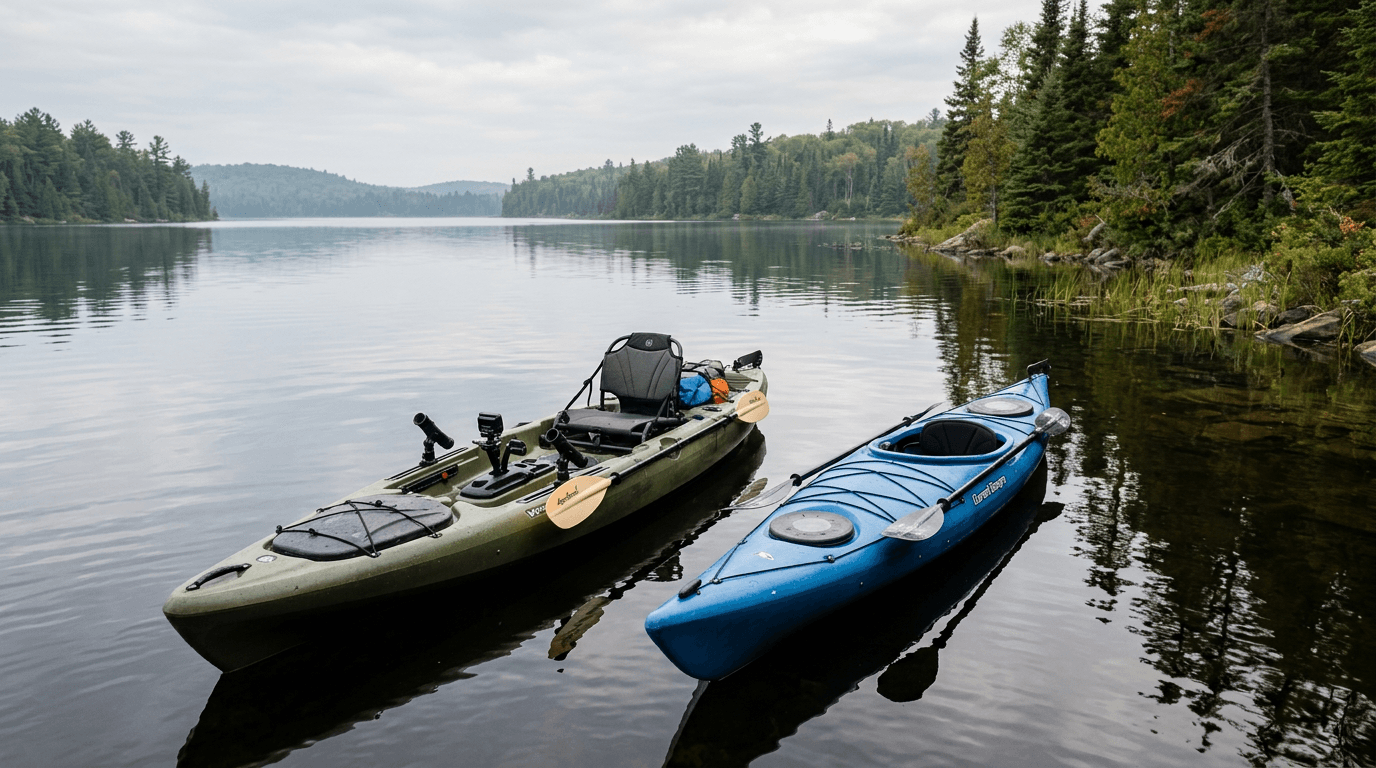
Angler Kayak vs Regular Kayak: 7 Key Differences That Change How You Fish
Angler kayak vs regular kayak — the real functional differences in stability, storage, speed, and cost. Plus whether your regular kayak is worth converting.
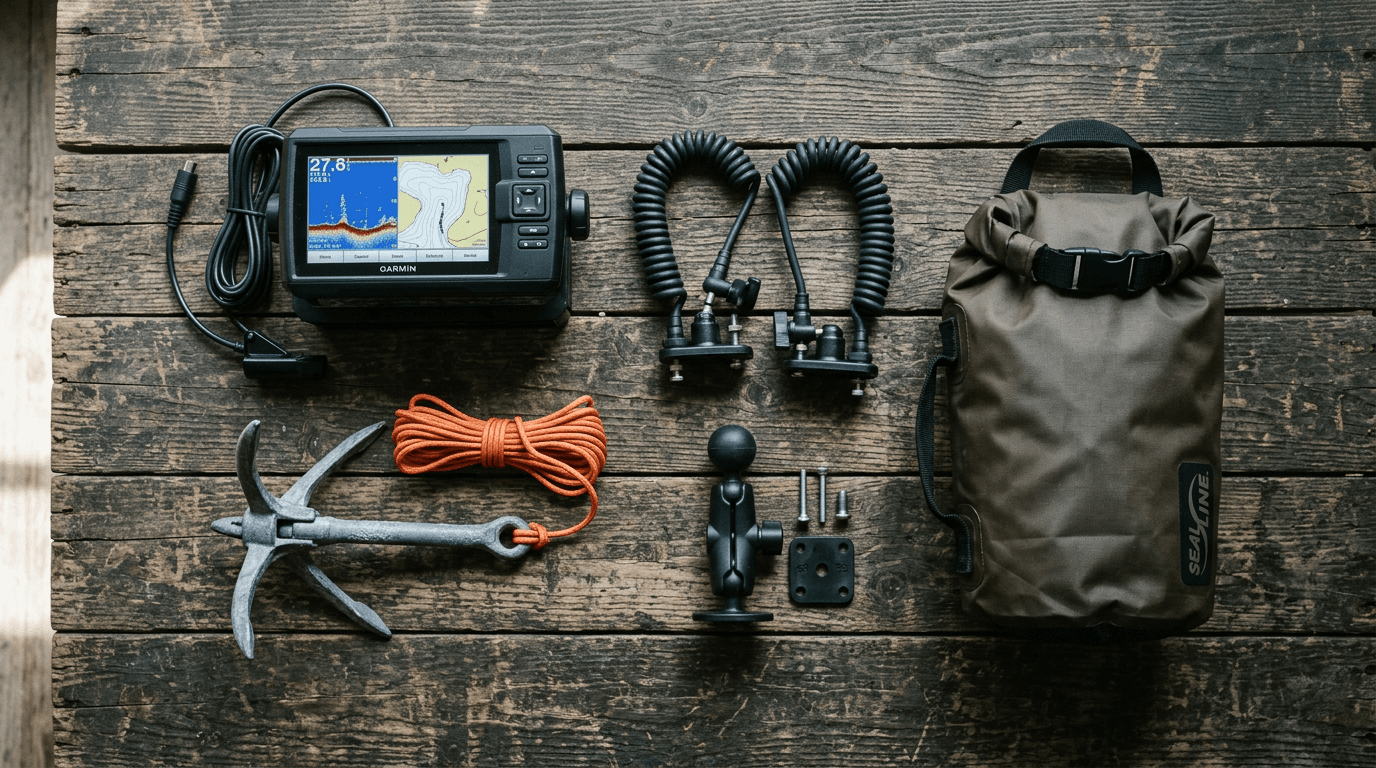
Fishing Kayak Attachments: The Complete Rigging and Mounting Guide
Best fishing kayak attachments explained — track systems, rod holders, fish finder mounts, anchors, and storage. What to buy, where to mount it, and how.
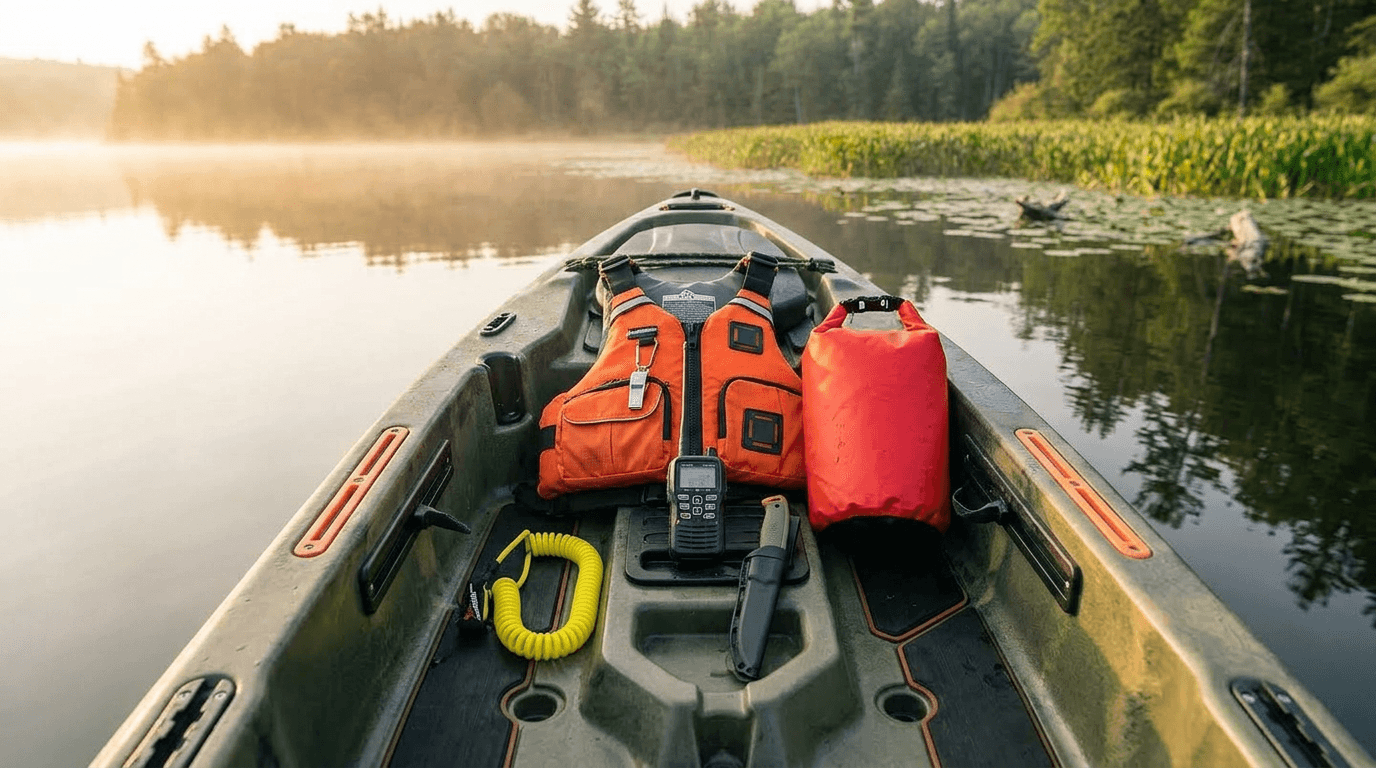
Kayak Fishing Safety Gear Checklist: 12 Must-Haves Before You Launch
Kayak fishing safety gear checklist: 12 must-haves, USCG legal requirements, and fishing-specific items most guides miss — with specific brand picks.