Affiliate Disclosure:This article contains affiliate links. If you purchase through our links, we may earn a small commission at no extra cost to you. We only recommend gear we've tested or would genuinely use ourselves.
top list • May 13, 2026 • 16 min read · The Bite Intel Team
Best Fish Finder for Kayak: 6 Units Tested for 2026
The best fish finders for kayak fishing — from the Garmin Striker 4 budget pick to the Deeper PRO+ castable sonar. Buyer's guide, mounting tips, and honest reviews.
There are two types of kayak anglers: those who fish blind, and those who know exactly where the bottom is, what's suspended in the water column, and where the fish are holding.
The difference isn't luck. It's a fish finder.
A good fish finder on a kayak changes the way you fish. Instead of blind-casting over 15 feet of nothing, you're finding the 8-foot shelf where bass are staging, the brush pile holding crappie, or the thermocline where walleye are suspended. You spend your time fishing productive water instead of casting over empty bottom.
The catch: not every fish finder is built for a kayak. Boat units are often too large, too power-hungry, and mounted in ways that won't work on a hull-level platform. This guide focuses on units that are practical on a kayak — right-sized screens, efficient power draw, and smart mounting options.
Best Fish Finders for Kayak: Quick Comparison
| Product | Rating | Price | Best For | Link |
|---|---|---|---|---|
| Garmin Striker 4 | 4.3/5 | $100–$130 | Budget pick / simplest setup | Check Price |
| Garmin Striker Plus 5cv | 4.5/5 | $200–$250 | Best mid-range value | Check Price |
| Humminbird Helix 5 | 4.6/5 | $250–$350 | Best overall / maps included | Check Price |
| Lowrance Hook Reveal 5 | 4.4/5 | $250–$300 | Best side imaging at this price | Check Price |
| Garmin Echomap UHD2 54cv | 4.7/5 | $350–$450 | Best image quality / open water | Check Price |
| Deeper PRO+ Smart Sonar | 4.2/5 | $200–$250 | Best castable / no mounting needed | Check Price |
#1 Best Budget Kayak Fish Finder: Garmin Striker 4
4.3/5The Garmin Striker 4 is the entry point that actually works. At $100–$130, it gives you everything a beginner kayak angler needs: CHIRP sonar, a GPS receiver for marking waypoints, and a 3.5-inch screen bright enough to read in daylight.
The screen is small — there's no getting around that. But on a kayak where your face is 18 inches from the mount, a 3.5-inch display reads clearly. You're not viewing it from 6 feet across a boat console.
The Striker 4 runs on CHIRP (Compressed High-Intensity Radiated Pulse) sonar, which gives you cleaner, more detailed returns than older single-frequency units. You'll see fish arches clearly separated from bottom clutter. The 77/200 kHz transducer covers a wide cone angle at 77 kHz (useful for wider coverage in shallow water) and a narrow cone at 200 kHz (better detail in deeper water).
It doesn't have maps — just a GPS breadcrumb trail that shows your track. No chartplotter functionality. For beginners learning to read sonar, this is fine. You're learning the fundamentals without the distraction of charts.
Power: runs on 12V and draws very little. A 7Ah lithium battery will power it all day.
Pros
- Lowest price point for functional CHIRP sonar
- Built-in GPS for waypoint marking
- Simple interface — almost no learning curve
- Compact size ideal for small kayak mounts
- Transducer included in the box
Cons
- 3.5" screen is small — harder to read in direct sunlight at an angle
- No maps or chartplotter
- No ClearVü / scanning sonar
- Basic bracket mount (you'll want a RAM-mount upgrade)
#2 Best Mid-Range: Garmin Striker Plus 5cv
4.5/5The Striker Plus 5cv is the natural step up from the Striker 4: a 5-inch screen, ClearVü scanning sonar, and the same proven CHIRP sonar foundation. At $200–$250, it's a significant jump from the budget Striker 4, but what you get in return is meaningfully better.
The 5-inch 800x480 display is the key upgrade. It's easier to read, easier to split between sonar and GPS views, and more detailed when you're trying to separate fish from structure.
ClearVü is Garmin's version of down-scanning sonar. Instead of the traditional cone-shaped sonar return, ClearVü sends a razor-thin beam directly below the transducer and returns a photo-realistic image of what's below the boat. Brush piles look like brush piles. Laydowns look like laydowns. It's dramatically more interpretable than traditional sonar for anglers learning to read the bottom.
It still doesn't have built-in maps, but the GPS marks waypoints and tracks your path accurately. If you fish the same bodies of water repeatedly and want to mark good spots, the GPS is all you need.
Pros
- 5" screen is the sweet spot for kayak use
- ClearVü provides detailed down-scan imaging
- CHIRP + ClearVü dual-beam capability
- GPS waypoints and track logging
- Garmin reliability and support
Cons
- No built-in maps — chartplotter users will want the Echomap series
- No side-scan (SideVü)
- Mount options require aftermarket RAM-ball for best positioning
#3 Best Overall: Humminbird Helix 5
4.6/5The Humminbird Helix 5 is the fish finder most kayak anglers end up recommending after a year on the water. It hits a combination of screen size, sonar quality, built-in mapping, and ease of use that no competitor matches at its price point.
The 5-inch 800x480 display is bright and readable. Dual Spectrum CHIRP sonar gives you broad coverage AND narrow beam in a single pass — it auto-optimizes based on depth and conditions. The imaging is clean and interpretable even for beginners.
What separates the Helix 5 from Garmin's mid-range is the built-in maps. Depending on which Helix 5 variant you buy (there are several — G4 is the current generation), you get either AutoChart Live capabilities (for mapping your own water) or preloaded maps. For lakes and reservoirs with contour data already loaded, you can navigate to structure without guessing.
The Helix series is known for outstanding customer support, an active user community, and regular firmware updates. If you buy one, it'll be supported for years.
Pros
- Best overall sonar quality at this price range
- Dual Spectrum CHIRP sonar — wide and narrow beam simultaneously
- Built-in mapping capabilities
- 5" bright display, readable in sunlight
- AutoChart Live for creating your own contour maps
- Strong user community and Humminbird support
Cons
- Slightly larger than Garmin units — check your mount space
- Menu navigation has a learning curve
- More expensive than Garmin mid-range options
#4 Best Side Imaging Value: Lowrance Hook Reveal 5
4.4/5The Lowrance Hook Reveal 5 is the only unit at this price point that bundles Tripleshot transducer technology — CHIRP sonar, StructureScan HD down imaging, and SideScan side imaging in a single transducer. For $250–$300, getting all three sonar modes is remarkable value.
SideScan is the key differentiator. It lets you see structure and fish off to the side of your kayak — not just what's directly below. When you're paddling a flat and want to see the weed edge 20 feet to your left without paddling over it, SideScan shows it to you. For bass and walleye anglers covering water, this is a game-changer.
The Hook Reveal also includes Navionics maps preloaded, which is a genuine value-add. You get real lake contours, depth lines, and structure marked before you even launch.
The downside: Lowrance's interface takes longer to learn than Garmin or Humminbird, and the build quality on the Hook series is slightly below the Helix 5. But if side imaging is on your priority list, no other unit at this price delivers it.
Pros
- Tripleshot transducer: CHIRP + down scan + side scan in one
- SideScan imaging at a price point where competitors don't offer it
- Navionics maps preloaded
- Autotuning sonar simplifies setup
- 5" display
Cons
- Lowrance interface is less intuitive than Garmin/Humminbird
- Build quality feels slightly below competitors at this price
- Navionics subscription required for map updates
#5 Best for Open Water: Garmin Echomap UHD2 54cv
4.7/5If you fish large lakes, reservoirs, or coastal water where GPS navigation matters as much as sonar, the Garmin Echomap UHD2 54cv is in a different league from everything else on this list.
UHD ClearVü (Ultra High Definition) produces the sharpest down-scan imaging Garmin makes at this price. Fish suspended in the water column show up as discrete targets. Structure is photo-realistic. In deeper water, the image quality difference over standard ClearVü is real.
The Echomap line is a proper chartplotter — it comes loaded with Garmin LakeVü HD maps that include detailed contour lines for thousands of U.S. inland lakes. The 5-inch touchscreen (with button backup) is one of the most responsive in the category.
For a kayak angler who primarily fishes familiar small ponds, this is overkill. But for someone covering large open-water fisheries — chasing walleye on a big reservoir, targeting stripers in a tidal estuary — the GPS and mapping capabilities justify the price.
Pros
- UHD ClearVü delivers the sharpest down-scan imaging at this price
- Full chartplotter with Garmin LakeVü HD maps preloaded
- Touchscreen interface is fast and intuitive
- Panoptix LiveScope compatible (upgrade path)
- 5" screen with excellent sunlight readability
Cons
- Most expensive unit on this list
- Overkill for small-water fishing
- Panoptix is a major additional cost if you want live sonar
#6 Best Castable: Deeper PRO+ Smart Sonar
4.2/5The Deeper PRO+ is fundamentally different from every other unit on this list. There's nothing to mount. You cast it into the water like a lure, and it transmits sonar data wirelessly to your phone via WiFi.
This design solves the biggest problem with fish finders on kayaks: transducer placement and permanent mounting. With the Deeper, you cast to an area you want to scan, let it sit or drift, and watch the sonar return on your phone screen. Want to scan the far bank without paddling over it? Cast the Deeper there.
The PRO+ has built-in GPS, which enables bathymetric mapping — you paddle your water body while the Deeper maps depth contours in real time, building a private map of your water that stores in the app. This is genuinely useful for lakes and ponds with no published contour data.
The limitations are real: smartphone screen visibility in direct sunlight is worse than a dedicated fish finder display, battery life is 4–5 hours (bring a USB power bank), and it only shows what's under the sonar ball, not a side-scan view. Fishing moving water with current is also tricky since the Deeper drifts.
For kayak anglers who fish multiple bodies of water, rent kayaks, or simply want the most flexible and packable sonar option, the Deeper is hard to beat.
Pros
- No mounting required — cast and fish
- Works from shore, dock, or kayak
- GPS bathymetric mapping builds your own lake maps
- Portable and travel-friendly — fits in a tackle bag
- Compatible with Android and iOS
Cons
- Phone screen visibility in sunlight is worse than dedicated displays
- Battery life 4–5 hours
- No display of its own — dependent on smartphone
- Less effective in current
Kayak Fish Finder Buying Guide
Transducer Type
Traditional CHIRP: The baseline. Sends a cone-shaped sonar signal below the kayak. Great for seeing fish arches and bottom composition. Wide cone at low frequency (77 kHz) for coverage in shallow water, narrow cone at high frequency (200 kHz) for detail in deeper water.
ClearVü / Down Scan: A thin razor-beam directly below the transducer. Returns a photo-realistic image of structure — you can see individual logs, rocks, and fish clearly rather than interpreting sonar arches. Essential for fishing structure-heavy water.
SideScan / SideVü: Sends beams to the left and right of the transducer simultaneously. Shows you what's off to the side. Excellent for scanning flats, finding weed edges, and locating fish positioned horizontally away from your kayak.
For beginners: CHIRP-only is fine. For anglers who fish lakes and structure: add ClearVü. For open-water anglers covering large areas: add SideScan.
Screen Size
On a kayak, a 5-inch screen is the practical sweet spot. You're close enough to read it clearly, and it's small enough to mount without taking over the cockpit. The 3.5-inch Garmin Striker 4 works fine at kayak range. Anything larger than 7 inches becomes impractical on most kayak setups.
GPS vs. No GPS
Get GPS. Even the budget Striker 4 includes it. The ability to mark your waypoints — productive structure, launch ramps, hazards — pays dividends immediately. On larger water, GPS navigation is a safety tool, not just a fishing tool.
Power Requirements
All of these units run on 12V DC. On a kayak, your options:
- Sealed 12V lead-acid battery (7–12 Ah): Cheap and heavy. Gets the job done.
- 12V lithium (LiFePO4): Much lighter, longer runtime, more expensive but worth it for fishing kayaks where weight matters.
- USB-powered units: Some smaller units (including certain Deeper modes) run from USB batteries — simpler but more limited.
A 7Ah lithium battery will power a Garmin Striker 4 for 15+ hours on a single charge.
Mounting Options for Kayaks
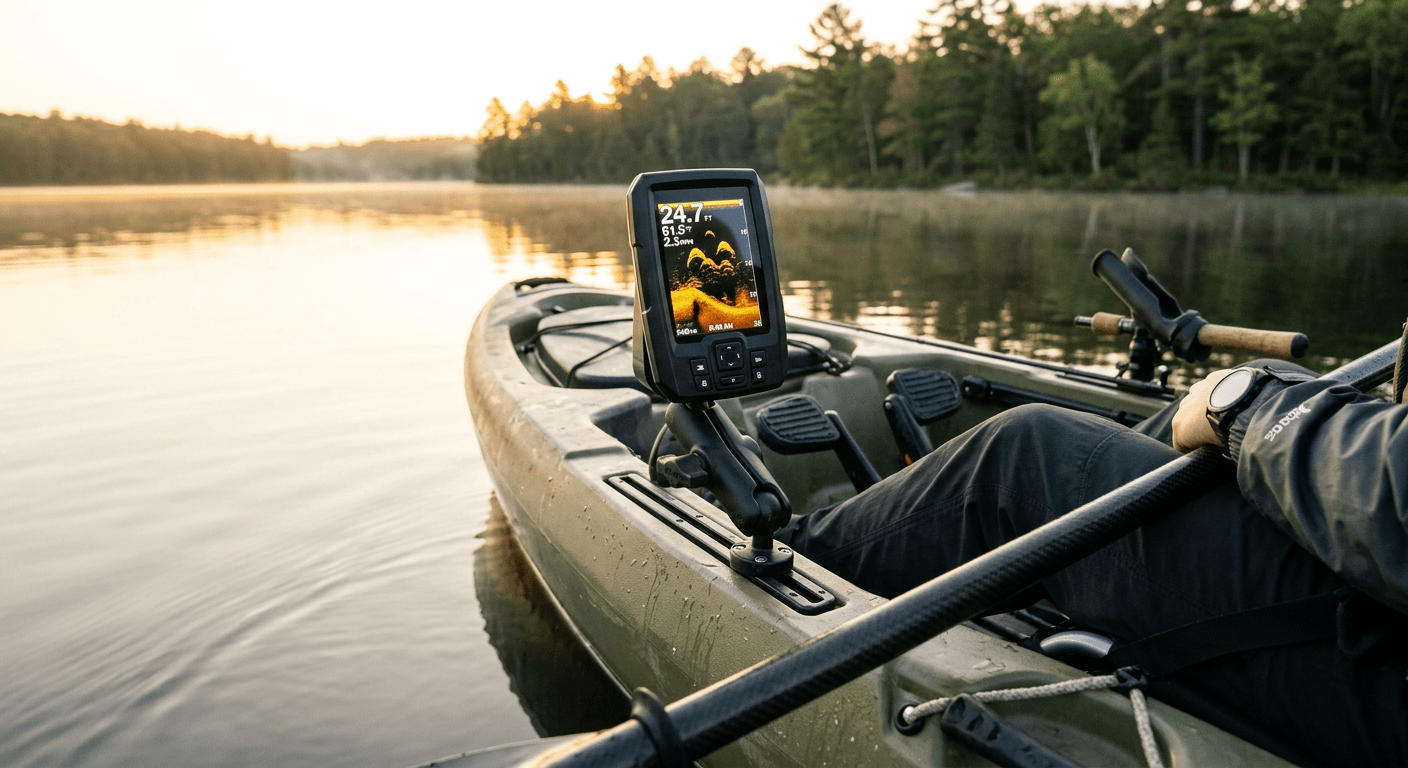
The included mount on most fish finders is a basic bracket designed for boat gunwales. On a kayak, you'll want a RAM mounting system — a ball-and-socket arm system that attaches to a RAM track base, rod holder flush mount, or suction cup.
The typical kayak fish finder mount is: RAM 1-inch or 1.5-inch ball base (track or rod holder mount) → RAM arm → fish finder mounting ball. This gives you full adjustability and the ability to swing the unit out of the way.
For rod holder-based mounting hardware and track systems: kayak rod holder buying guide.
How to Mount a Fish Finder on a Kayak
-
Choose your mount location: The most common spot is the front right of the kayak (for right-handed anglers), within easy viewing distance. Some kayaks have dedicated fish finder mount pads.
-
RAM mount base: Install a RAM track base in an existing gear track, or use a RAM rod holder mount (fits in existing flush-mount rod holders). No drilling required for either option.
-
Run the transducer cable: Route it under the deck rigging or through existing cable ports. Use cable clips to keep it tidy.
-
Transducer placement: The transducer needs to be in the water. Options include:
- Through-hull (scupper mount): Run the transducer cable through a scupper hole with a specialized adapter.
- Suction cup mount: Attach temporarily to the hull inside (for composite kayaks) or outside.
- Trolling motor or pole mount: If you run a kayak motor, the transducer can attach to the motor shaft.
-
Power connection: Run your cable to a 12V battery stored in the crate or a bow compartment.
Frequently Asked Questions
Q: Do I need a fish finder to catch fish from a kayak?
No. Plenty of great kayak anglers fish entirely by reading the water — looking for visible structure, depth changes, weed lines, and current seams. A fish finder accelerates the learning process and increases efficiency, but it's not a requirement. It becomes more valuable as you fish more varied and unfamiliar water.
Q: Will a fish finder work in very shallow water?
Yes, though performance varies. Most CHIRP transducers read accurately from about 2 feet down. In water shallower than 2 feet, the bottom signal and the surface clutter can overlap. The Deeper PRO+ actually performs better in very shallow water than some boat-mounted units because it's floating at the surface directly in the water column.
Q: Can I use a fish finder with a solar panel?
Yes. A 10–20W solar panel can trickle-charge a 12V battery while you're on the water, extending your runtime indefinitely on sunny days. This is popular on all-day kayak fishing trips.
Q: What's the difference between a fish finder and a chartplotter?
A fish finder shows you what's in the water below your transducer. A chartplotter shows GPS maps and navigation data. Many units (like the Echomap) are both. Budget units like the Striker 4 have GPS for waypoints but no charts — it's a fish finder with GPS, not a chartplotter.
Q: How do I protect my fish finder from water?
All of these units are waterproof at the display — they're rated for spray and rain. What's not waterproof is the connection between the power cable and battery. Use marine-grade connectors and keep the battery connection in a dry bag or protected compartment.
Q: Can I leave my fish finder mounted on the kayak?
You can, but don't. RAM mounts make removal a 10-second job. The display is vulnerable to UV degradation and theft. Take it off and store it inside after every trip.
Final Verdict: Which Kayak Fish Finder Is Right for You?
| Product | Rating | Price | Best For | Link |
|---|---|---|---|---|
| Garmin Striker 4 | 4.3/5 | $100–$130 | Tight budget, first fish finder | Check Price |
| Garmin Striker Plus 5cv | 4.5/5 | $200–$250 | Best step-up from budget | Check Price |
| Humminbird Helix 5 | 4.6/5 | $250–$350 | Best overall — maps + sonar | Check Price |
| Lowrance Hook Reveal 5 | 4.4/5 | $250–$300 | Best side imaging value | Check Price |
| Garmin Echomap UHD2 54cv | 4.7/5 | $350–$450 | Best for large open water | Check Price |
| Deeper PRO+ Smart Sonar | 4.2/5 | $200–$250 | Best castable / no mounting | Check Price |
On a tight budget: Garmin Striker 4. It does what it says, works on every kayak, and the learning curve is nearly zero.
Best overall: Humminbird Helix 5. The combination of sonar quality, screen, and mapping puts it ahead of everything at the same price.
For open water and serious navigation: Garmin Echomap UHD2 54cv. Don't compromise on mapping when you're fishing large lakes and reservoirs.
For versatility without mounting: Deeper PRO+ Smart Sonar. Takes it fishing on any kayak, any pond, any trip.
Related Posts
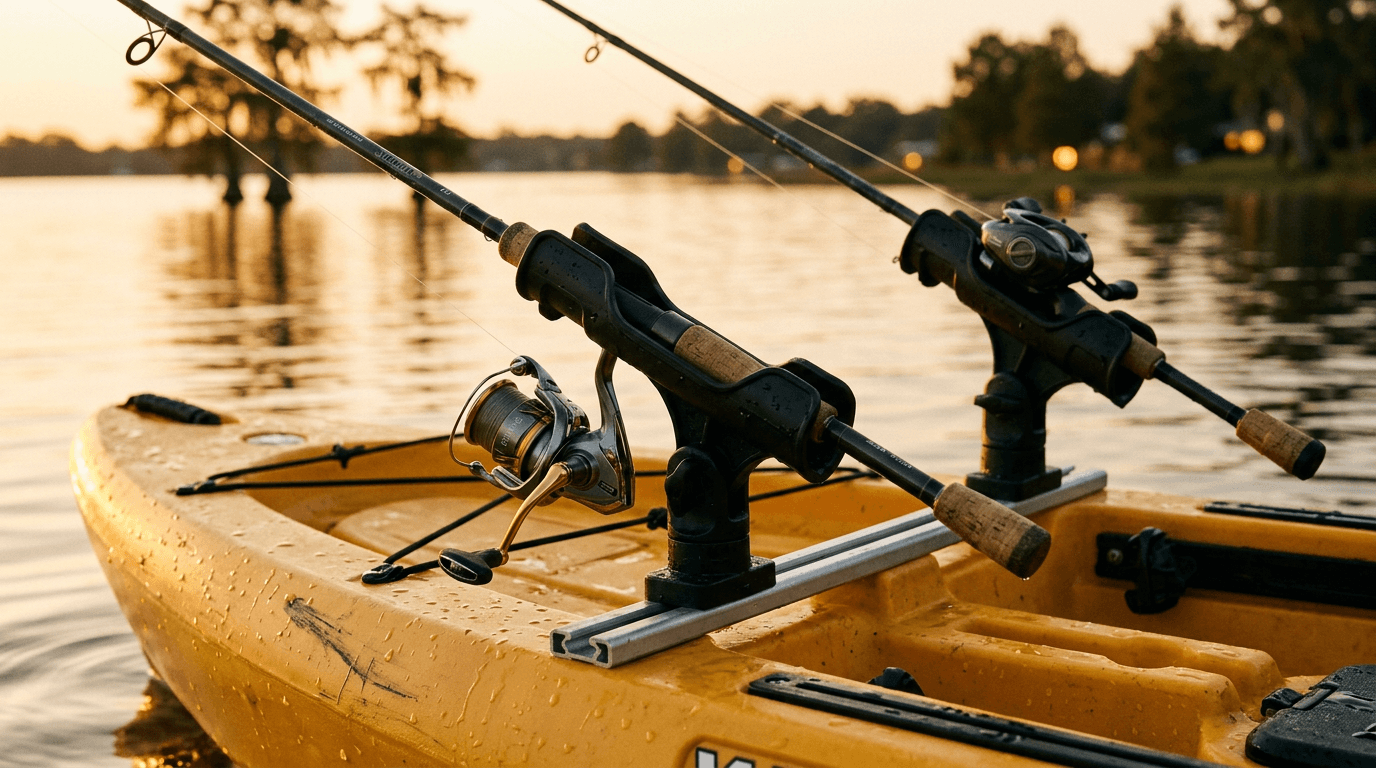
Best Rod Holders for Fishing Kayaks: 7 Tested Picks for Every Setup
Best rod holders for fishing kayaks reviewed and ranked: 7 picks from YakAttack, Scotty, and Railblaza for flush mount, track mount, and no-drill installs.
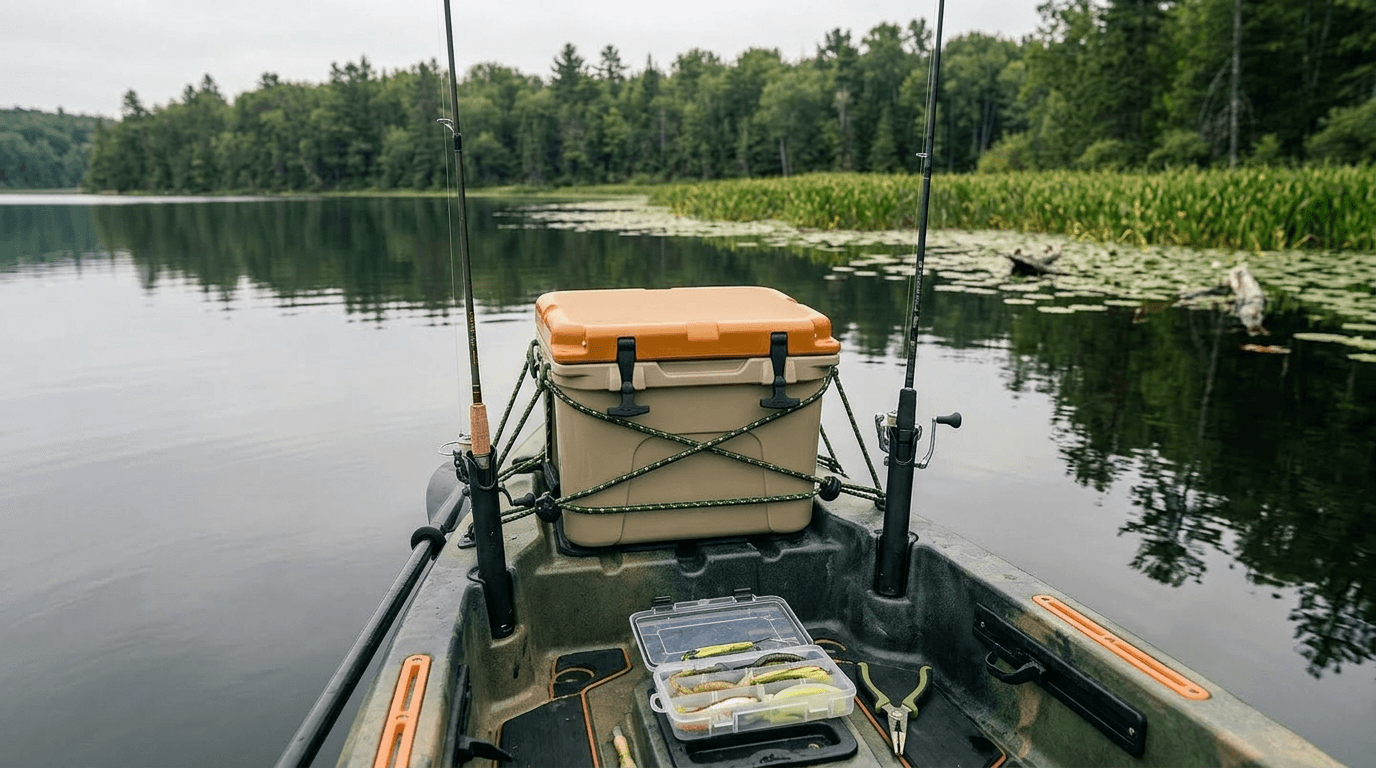
Best Cooler for Kayak Fishing in 2026 (6 Picks Reviewed)
The best coolers for kayak fishing — covering hard coolers, soft coolers, size, ice retention, and how to fit one on your kayak without sacrificing storage or stability.
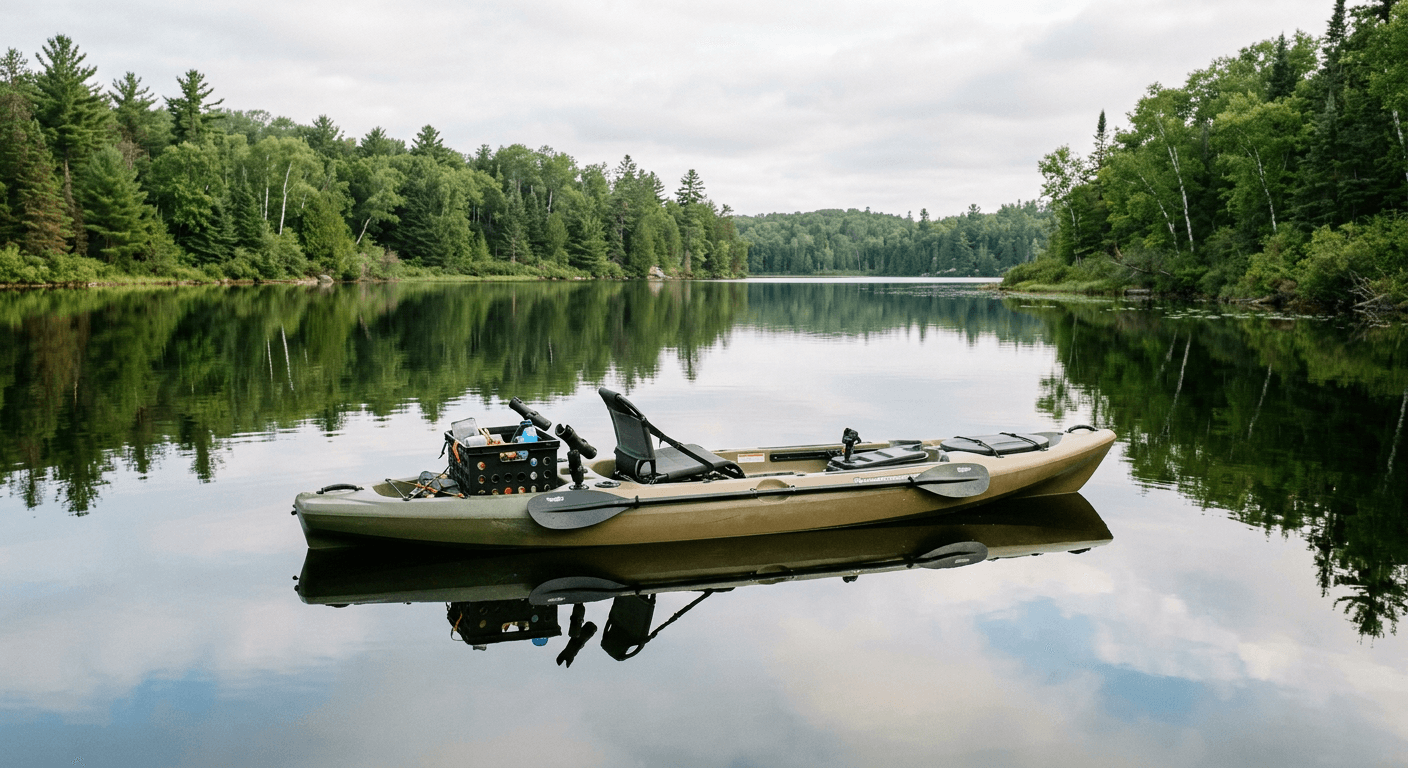
Best Fishing Kayaks Under $1000: 6 Picks That Actually Catch Fish
The best fishing kayaks under $1000 reviewed — Pelican Catch 110, Perception Pescador Pro, Lifetime Tamarack, and more. Honest reviews, specs, and who each one is right for.