Affiliate Disclosure:This article contains affiliate links. If you purchase through our links, we may earn a small commission at no extra cost to you. We only recommend gear we've tested or would genuinely use ourselves.
top list • May 13, 2026 • 16 min read · The Bite Intel Team
Best Trolling Motor for Kayak in 2026 (6 Picks Tested)
The best trolling motors for kayak fishing — from budget 30 lb thrust picks to GPS anchor motors. Covers thrust, shaft length, battery requirements, and mounting tips.
A trolling motor changes everything about kayak fishing. Instead of fighting current with a paddle to hold position on a point, or burning energy repositioning after every drift, you're hands-free — focused entirely on your rod. You cover more water, fish more effectively, and come off the water less exhausted.
But choosing the wrong motor for a kayak is an expensive mistake. Too much thrust and you're lugging extra weight that slows you down. Wrong shaft length and the prop cavitates out of the water every time a wake passes. Freshwater motor on saltwater and you're fighting corrosion after the first season.
This guide covers the six best trolling motors for kayak anglers in 2026, from a 30 lb budget freshwater pick to a full GPS anchor unit, with a complete buying guide covering everything you need to make the right call.
Best Trolling Motors for Kayaks at a Glance
| Product | Rating | Price | Best For | Link |
|---|---|---|---|---|
| Minn Kota Endura C2 30 | 4.3/5 | $ | Budget freshwater | Check Price |
| Newport Vessels NV-Series 55lb | 4.5/5 | $$ | Best mid-range overall | Check Price |
| Watersnake ASP T18 | 4.1/5 | $ | Ultra-compact / lightest | Check Price |
| MotorGuide Xi3 55lb | 4.7/5 | $$$$ | GPS anchor / wireless control | Check Price |
| Minn Kota Riptide 55 | 4.6/5 | $$$ | Best for saltwater | Check Price |
| Cloud Mountain 55lb Trolling Motor | 4/5 | $ | Tightest budget pick | Check Price |
#1 Best Mid-Range: Newport Vessels NV-Series 55lb
4.5/5The Newport Vessels NV-Series hits the sweet spot for most kayak anglers. You get genuine 55 lb thrust, a built-in LED battery indicator (so you're not guessing how much runtime you have left), variable speed control, and a 36-inch shaft that keeps the prop submerged on most kayak hulls.
The motor weighs about 18 lbs — heavy enough that you feel it, but manageable for most anglers to mount and dismount at the ramp. The 8-point LED battery meter is the standout feature at this price point. Most budget motors skip this entirely, leaving you stranded mid-lake.
At 52 amps of draw at full thrust, you'll want at least a 50Ah battery to get a full day's fishing. The build quality is solid for the price — this motor holds up well across multiple seasons when rinsed after saltwater use, though it's not rated for marine environments like the Riptide.
Pros
- LED battery indicator is genuinely useful all day
- Variable speed (not just 5 fixed speeds) gives precise control
- 55 lb thrust handles current and wind without strain
- Strong value for the price — well under mid-range competitor pricing
Cons
- 18 lbs is heavier than lighter kayak-specific motors
- Not rated for saltwater — rinse after any brackish use
- Tiller handle is basic; no wireless option at this price
#2 Best Budget Freshwater: Minn Kota Endura C2 30
4.3/5The Endura C2 30 is the entry point for first-time trolling motor buyers, and it earns its reputation. Minn Kota has been making trolling motors for decades and the Endura line reflects that — the composite shaft doesn't corrode, the 5-speed control is dead simple, and the telescoping handle gives you reach without fighting it from a kayak seat.
At 30 lb thrust it's genuinely underpowered in wind or heavy current, but for calm lakes and slow rivers it does exactly what a beginner needs: hold position, troll at consistent slow speeds, and get you down a shoreline hands-free. The 30A draw means even a modest 35Ah battery will run it most of the day.
It weighs just 8 lbs, which matters enormously when you're mounting it on a kayak bow, stern, or side mount. The lighter setup also affects kayak balance less than heavier motors — a real concern when you're already loaded with a fish finder and gear.
Pros
- Very light at 8 lbs — minimal impact on kayak balance
- Simple 5-speed control, nothing to learn or configure
- Telescoping tiller handle works well from kayak seating height
- Excellent price for a reliable Minn Kota motor
Cons
- 30 lb thrust is marginal in wind above 10 mph or real current
- No battery indicator — you need a separate meter
- Freshwater only — not suitable for saltwater or brackish use
#3 Best Ultralight: Watersnake ASP T18
4.1/5The Watersnake ASP is the trolling motor for anglers who want a motor that genuinely doesn't change the feel of paddling. At 18 lb thrust and a featherweight build, this motor is designed specifically for small watercraft — kayaks, canoes, and inflatables.
The 24-inch shaft is shorter than most trolling motors, which is intentional — on a kayak you're sitting low and the prop doesn't need the same depth clearance as a boat-mounted motor. It runs on a single 12V battery, draws minimal amps, and produces almost no wake or noise.
The tradeoff is obvious: 18 lb thrust is not going to push you against a stiff headwind or through fast current. This is a positioning motor — ideal for holding station on a bass flat, moving quietly along a shoreline at slow speed, or covering small bodies of water. If you fish bigger water or deal with wind regularly, step up to the Newport Vessels.
Pros
- Extremely light — barely changes kayak handling
- 24-inch shaft works perfectly on shallow-draft kayak hulls
- Very quiet — excellent for spooky fish in shallow water
- Low amp draw extends battery life significantly
Cons
- 18 lb thrust is not enough for open water or wind above 8 mph
- No battery indicator
- Limited to calm, protected water scenarios
#4 Best GPS Anchor: MotorGuide Xi3 55lb
4.7/5If you fish structure — points, humps, ledges, channel edges — the MotorGuide Xi3 with Pinpoint GPS is a serious tool. The GPS anchor function holds your position within a few feet without you touching anything. You drop a waypoint and the motor makes micro-adjustments constantly to keep you planted. On a windy day over a submerged point, this is genuinely game-changing.
The wireless foot pedal control means you're running the motor with your feet while both hands stay on the rod — the same setup serious tournament anglers use from bass boats, adapted for a kayak mount. The Xi3 also pairs with the Humminbird HELIX and Mega fishfinder ecosystem if you're already running that platform.
This is a premium motor at a premium price. It's only appropriate for anglers who have already committed to a serious kayak fishing setup and want boat-level fishing efficiency. Pair it with quality outriggers for stability before running a motor this size on a narrower kayak hull.
Pros
- GPS anchor holds position within a few feet — no drift while you fish
- Wireless foot control keeps both hands free for fishing
- Pinpoint GPS integrates with Humminbird fish finders
- Digital power management extends battery runtime efficiently
Cons
- Expensive — significant investment over other options
- Heavier than lighter motors; affects kayak balance more
- GPS anchor requires initial learning curve to use effectively
- Overkill for casual or beginner kayak anglers
#5 Best for Saltwater: Minn Kota Riptide 55
4.6/5Every component on the Riptide 55 is built for the marine environment. The shaft is stainless steel. The motor housing uses a saltwater-rated composite and corrosion-resistant hardware. The prop is designed to handle the debris and vegetation common in coastal and brackish water environments.
If you fish inshore — flats, backwaters, estuaries — or mix fresh and saltwater throughout the season, the Riptide is the motor to buy. Running a freshwater motor in saltwater is a fast way to corrode bearings, fittings, and shaft hardware. The Riptide is built to last in that environment without the constant maintenance battle.
At 55 lb thrust it has enough power to push against tidal current and handle the chop you get on coastal bays. The 5-speed control is simple and reliable. It's not as feature-rich as the Xi3 but it's the right tool for saltwater kayak fishing where reliability and corrosion resistance matter more than GPS anchoring.
Pros
- Fully rated for saltwater and brackish environments
- Stainless steel shaft resists corrosion in marine use
- 55 lb thrust handles tidal current and coastal chop
- Minn Kota reliability and parts availability
Cons
- No GPS anchor or wireless control at this price
- Heavier than budget alternatives
- Freshwater anglers can get similar performance for less with the Newport
#6 Budget Pick: Cloud Mountain 55lb Trolling Motor
4.0/5The Cloud Mountain 55lb is the choice for anglers who want 55 lb thrust without paying for a name-brand motor. For the price, it delivers more thrust than the Endura C2 30 and keeps costs well below the Newport Vessels.
The build quality is noticeably lighter than Minn Kota or Newport Vessels — the materials feel less refined and the controls are more basic. But for calm lake fishing, occasional use, or anglers testing out a trolling motor for the first time before committing to a higher-end unit, it gets the job done.
Rinse it well after every use, don't push it in conditions it's not rated for, and it'll hold up through a season or two. Don't expect the longevity of the name-brand motors, but for the price it's a legitimate entry point.
Pros
- 55 lb thrust at a budget price point
- Variable speed control included
- Good starting motor for first-time trolling motor users
Cons
- Build quality noticeably lower than name-brand motors
- Limited warranty and parts support compared to Minn Kota/Newport
- Not rated for saltwater — freshwater only
Trolling Motor Buying Guide for Kayaks
How Much Thrust Do You Need?
The general rule is 2 lbs of thrust per 100 lbs of total weight (kayak + angler + gear). A 200 lb angler in a 70 lb kayak with 30 lbs of gear is pushing 300 lbs total — meaning 30 lb thrust is the absolute minimum, and 55 lb is the comfortable working margin.
The real-world version: 30 lb thrust is adequate for calm conditions with minimal wind or current. For any real-world fishing — moving water, wind above 8 mph, open water — 55 lb thrust is the practical starting point.
Don't undersize trying to save weight. A motor that's working at 100% capacity all day drains your battery faster than a properly sized motor running at 60%.
Shaft Length
Shaft length determines whether your prop stays submerged when the kayak pitches on chop. Too short and the prop cavitates — spinning in air instead of water — which kills efficiency and makes a terrible noise.
Standard kayak shaft lengths:
- 24 inches — Watersnake-style compact motors; works on ultra-low-profile kayak hulls
- 30–36 inches — Standard for most sit-on-top fishing kayaks
- 42 inches — For kayaks with elevated bow mounting or for anglers who need more depth clearance in rough water
When in doubt, go longer. A prop that runs too deep is less of a problem than one that cavitates.
12V vs 24V Systems
Most kayak motors run on 12V. A single group 27 or group 31 deep cycle battery handles any 12V motor in this guide. 24V systems require two 12V batteries wired in series, doubling your battery weight — impractical for most kayak setups.
Stick with 12V unless you're running a large high-thrust motor (80+ lbs) on a very large kayak or tandem setup.
Freshwater vs Saltwater
Saltwater motors (like the Riptide) cost more because the materials cost more. For freshwater-only anglers, you're paying for features you don't need. For saltwater anglers, a freshwater motor in the ocean is false economy — the corrosion damage comes faster than you expect.
If you fish anywhere with salt, buy a saltwater motor. Rinse it after every use anyway, but start with corrosion-resistant materials.
How to Mount a Trolling Motor on a Kayak
Kayaks don't have the motor mount brackets of a bass boat, so mounting requires a purpose-built kayak trolling motor mount. There are three main options:
Bow mount — The most common setup. Mounts near the bow of the kayak, points the motor (and therefore the kayak) directly at your target. Gives the best directional control. Requires a bow mount bracket designed for your kayak model.
Stern mount — Mounts at the rear. Simpler to install and works well for straight-line trolling, but steering is less intuitive since you're pushing the kayak from behind.
Side mount — Mounts on the gunwale or side rail. Common on wider kayaks. Keeps the motor accessible without a bow or stern bracket installation.
Battery placement matters as much as motor placement. Keep the battery low in the hull (in the tank well if possible) and centered side-to-side. A heavy battery mounted high or off-center dramatically affects stability. See our guide on how to rig a kayak for fishing for a full walkthrough of setup and weight distribution.
Adding a motor changes your kayak's center of gravity. If you're running a larger motor on a narrower hull, consider kayak outriggers for stability insurance. For waterproofing battery connections, a dry bag or waterproof case keeps connectors and terminals protected from spray.
Battery Guide: What You Need for a Full Day
The motor's amp draw at full thrust, and how often you actually run at full thrust, determines your battery size requirement.
| Motor | Amp Draw (Full) | Recommended Battery | Est. Runtime at 50% Throttle |
|---|---|---|---|
| Minn Kota Endura C2 30 | 30A | 35Ah group 24 | 4–5 hours |
| Newport Vessels 55lb | 52A | 50Ah group 27 | 4–5 hours |
| Watersnake ASP T18 | ~15A | 25Ah | 5–6 hours |
| MotorGuide Xi3 55lb | 50A | 50Ah group 27 | 4–5 hours |
| Minn Kota Riptide 55 | 52A | 50Ah group 27 | 4–5 hours |
| Cloud Mountain 55lb | 50A | 50Ah group 27 | 4–5 hours |
Battery types to consider:
- AGM (Absorbent Glass Mat) — Spill-proof, no maintenance, handles vibration well. Good all-around choice for kayak use.
- Lithium (LiFePO4) — Significantly lighter than AGM (often 50% weight savings), deeper discharge, longer cycle life. Expensive but increasingly popular for kayak builds where weight matters.
A 50Ah AGM group 27 battery weighs around 40 lbs. A comparable lithium battery weighs 15–18 lbs — a significant difference when you're loading a kayak. For a complete look at building out your kayak setup, see our kayak fishing setup for beginners guide.
Tip
Avoid running any deep cycle battery below 50% discharge. Running to 80–90% discharge shortens battery life significantly. Size your battery so you're using the top 50% of its capacity for a full day on the water.
Frequently Asked Questions
Do I need a special mount to use a trolling motor on a kayak? Yes. Kayaks don't have the built-in motor mount brackets of bass boats. You'll need a purpose-built kayak trolling motor mount — available for bow, stern, or side mounting positions. Check compatibility with your specific kayak model before purchasing.
Will a trolling motor flip my kayak? Not if you mount it properly and distribute weight correctly. Keep the battery low and centered, don't run the motor at full thrust in tight turns, and add outriggers if you're running a larger motor on a narrower hull.
How long does a trolling motor battery last? At 50% throttle — where most anglers actually run — a properly sized 50Ah battery runs 4–5 hours with a 55 lb motor. Running wide open consistently cuts that significantly. Plan on a full day being 5–6 hours of actual motor use with brief breaks.
Can I use a car battery with a trolling motor? Technically yes, but car batteries (starting batteries) aren't designed for the deep discharge cycles a trolling motor demands. They degrade quickly in this application. Use a marine deep cycle AGM or lithium battery.
What's the difference between 30 lb and 55 lb thrust in practice? In calm water with no wind, you won't notice much difference for basic trolling and positioning. In wind above 8 mph, or any real current, 30 lb thrust starts struggling where 55 lb handles it easily. Buy the thrust level that matches the worst conditions you'll fish in, not the average.
Do I need a saltwater motor for brackish water? Yes. Brackish estuaries and tidal rivers are corrosive enough to damage freshwater-rated motor hardware. If you ever fish water that has any salt influence, invest in a saltwater-rated motor.
Final Verdict: Best Trolling Motor by Use Case
| Use Case | Best Pick |
|---|---|
| Best budget (freshwater, calm water) | Minn Kota Endura C2 30 |
| Best overall value | Newport Vessels NV-Series 55lb |
| Best ultralight / minimal setup | Watersnake ASP T18 |
| Best GPS anchor / tournament fishing | MotorGuide Xi3 55lb |
| Best for saltwater / inshore | Minn Kota Riptide 55 |
| Tightest budget, more thrust | Cloud Mountain 55lb |
For most kayak anglers buying their first motor, the Newport Vessels NV-Series 55lb is the right call. It has enough thrust for real conditions, the battery indicator saves you from getting stranded, and the price leaves room in your budget for the battery and mounting hardware you'll also need.
Saltwater anglers should go straight to the Minn Kota Riptide 55 — don't try to save money here with a freshwater motor. And if you're fishing structure and want to fish the way serious kayak bass anglers fish, the MotorGuide Xi3 GPS anchor system is worth every dollar once you've fished with it.
Pair your motor with a fish finder and you have a kayak setup that fishes as efficiently as a bass boat — at a fraction of the cost.
Related Posts
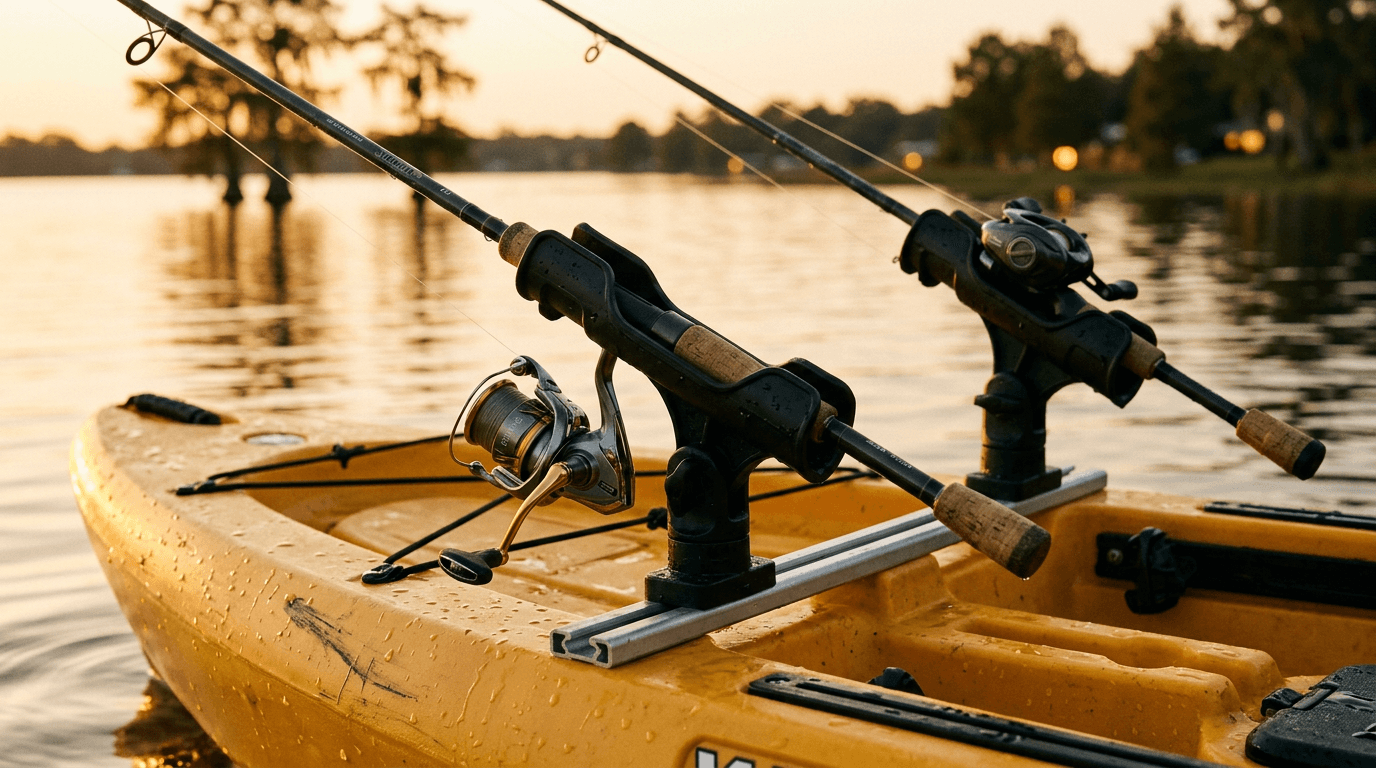
Best Rod Holders for Fishing Kayaks: 7 Tested Picks for Every Setup
Best rod holders for fishing kayaks reviewed and ranked: 7 picks from YakAttack, Scotty, and Railblaza for flush mount, track mount, and no-drill installs.
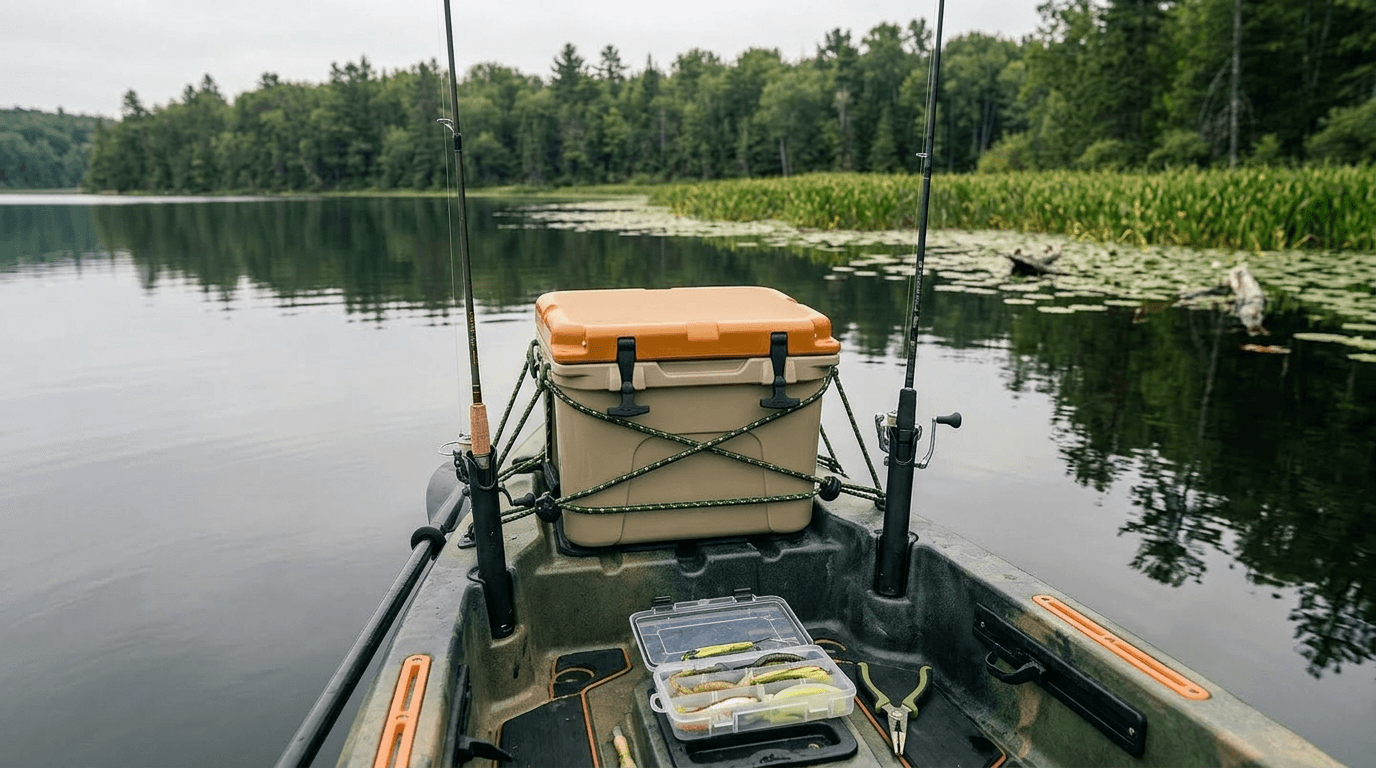
Best Cooler for Kayak Fishing in 2026 (6 Picks Reviewed)
The best coolers for kayak fishing — covering hard coolers, soft coolers, size, ice retention, and how to fit one on your kayak without sacrificing storage or stability.
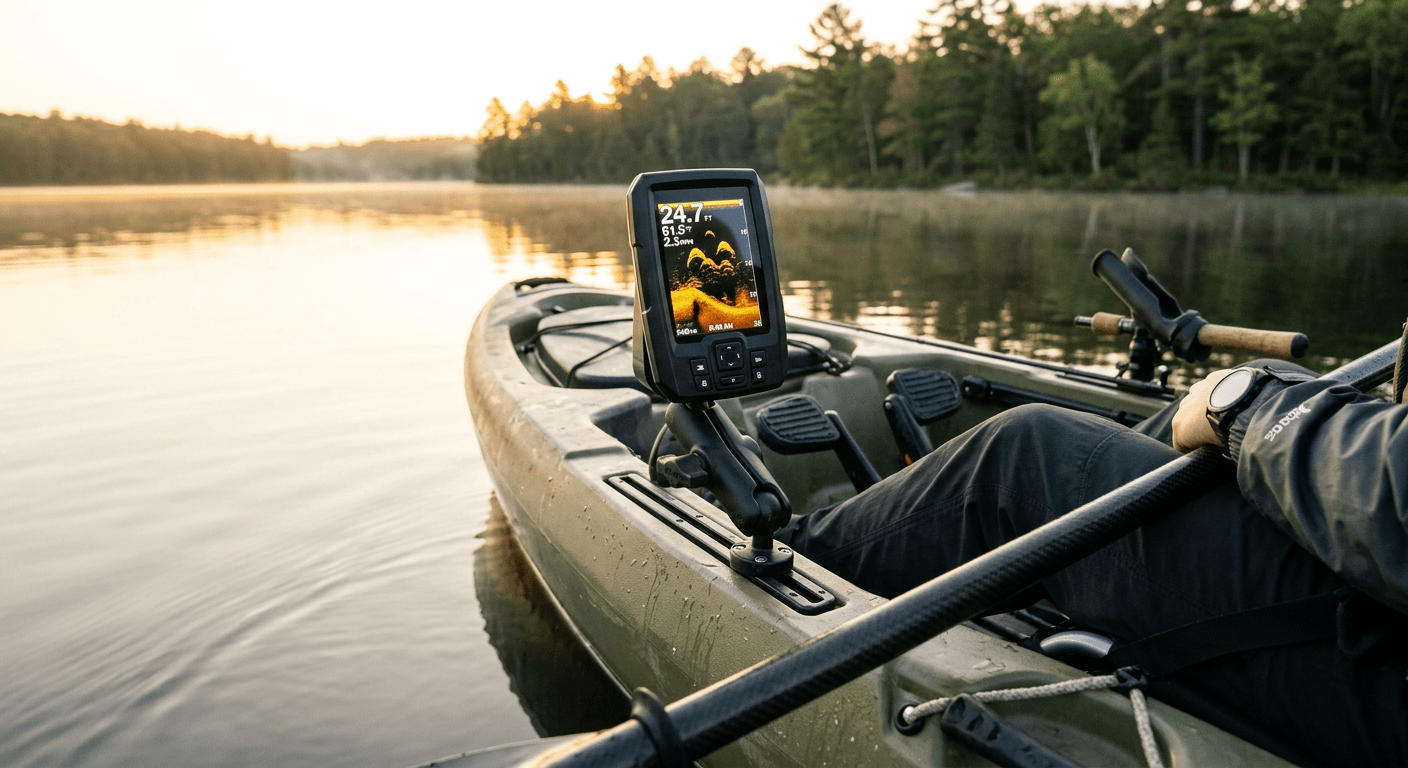
Best Fish Finder for Kayak: 6 Units Tested for 2026
The best fish finders for kayak fishing — from the Garmin Striker 4 budget pick to the Deeper PRO+ castable sonar. Buyer's guide, mounting tips, and honest reviews.